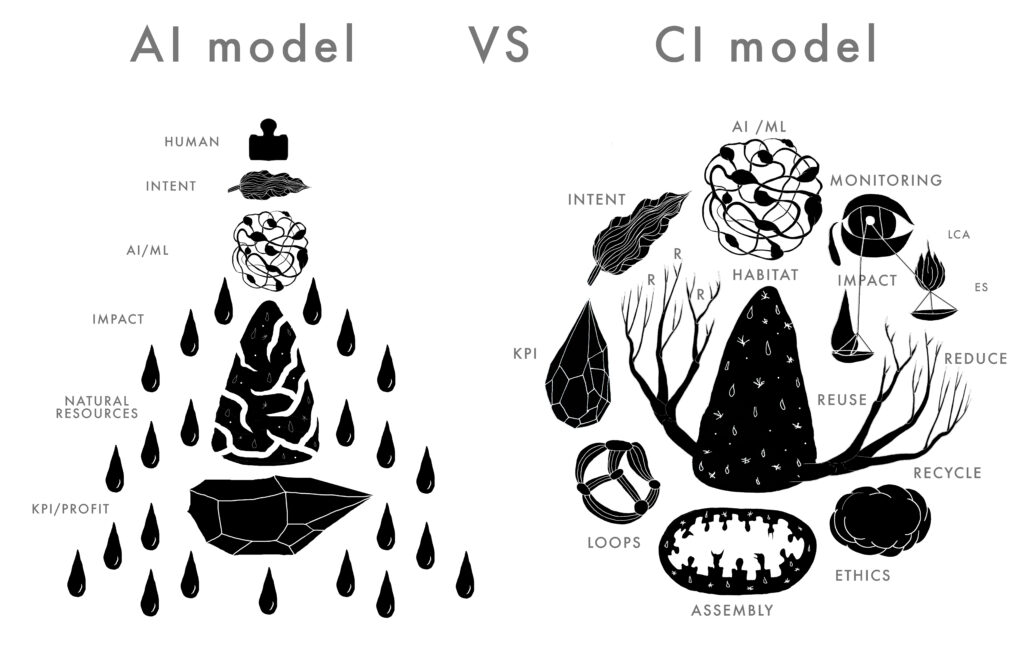
Andrea Conte (Andreco), AI model VS CI model. Andreco studio. Climate Art Project. 2024
Rethinking artificial intelligence through ecology, ethics, art and circular economy to imagine a more symbiotic relationship between technology and the living world.
Technology is not inherently a threat. What matters is how we choose to design, develop and use it.
As artificial intelligence rapidly transforms our societies, its growing environmental footprint raises urgent questions about energy consumption, natural resources, biodiversity, social justice and the future of our shared habitat.
Can artificial intelligence evolve from an extractive technology into a regenerative system that contributes to the well-being of humans and non-human living beings?
This question is at the heart of the scientific paper “From artificial to circular intelligence to support the well-being of our habitat,” co-authored by Andrea Conte (Andreco) and an international interdisciplinary team of researchers.
The paper introduces Circular Intelligence (CIntel), a conceptual and procedural framework inspired by the functioning of natural ecosystems, where resources circulate, interconnected systems adapt, and regeneration sustains life.
Bringing together expertise in artificial intelligence, Nature-based Solutions, environmental humanities, philosophical ethics, Life Cycle Assessment (LCA), ecosystem services, circular economy and contemporary art, the research proposes a paradigm shift: from resource-intensive, extractive AI towards circular, regenerative and ecologically integrated intelligence.
Rather than simply mitigating the negative impacts of technology, Circular Intelligence aims to integrate environmental and ethical considerations into the design of AI systems from the outset.
The proposed framework promotes resource efficiency, reuse of data and computational resources, continuous ecological monitoring, community participation and economic mechanisms based on shared costs and distributed benefits.
Crucially, it recognises that humans, machines and natural ecosystems are not separate entities, but interconnected components of a shared habitat.
Artistic research also plays an important role in this interdisciplinary process, helping to visualise complex relationships, bridge different fields of knowledge and imagine alternative technological futures.
Introducing the Circular Intelligence Manifesto
Building on this research, we are also launching the Circular Intelligence Manifesto, an invitation to rethink the relationship between technological innovation, ecological systems and collective well-being.
The Manifesto advocates a fundamental cultural and technological shift: moving beyond a predominantly anthropocentric and extractive model of artificial intelligence towards one grounded in ecological interdependence, environmental justice, circularity and collective responsibility.
It encourages researchers, artists, engineers, designers, policymakers and communities to imagine and develop technologies that learn from nature’s capacity to adapt, cooperate and regenerate.
Intelligence should not be measured only by computational power, efficiency or economic growth, but also by its capacity to sustain life, protect ecosystems and generate shared well-being.
Circular Intelligence is not simply about making artificial intelligence less harmful. It is about questioning its underlying purpose and exploring how technology could become an active participant in more regenerative relationships with the living world.
From extractive artificial intelligence to regenerative circular intelligence.
This is the transition we invite everyone to explore.
Explore the research and the Manifesto
Read the scientific paper:
From artificial to circular intelligence to support the well-being of our habitat
Discover the Circular Intelligence Manifesto:
https://circularintelligence.lovable.app/
Authors of the scientific paper: Francesca Larosa, Daniel Depellegrin, Andrea Conte, Marco Molinari, Adam Wickberg, Silvia Santato, Fermin Mallor and Anna Sperotto.
Available on arXiv, December 2025.
From Research to Artistic and Educational Practice
As Studio Andreco, Futurecologies and Climate Art Project, we have also explored the critical use of artificial intelligence in educational and creative practices through a workshop and a public performance at the Teatro di San Carlo in Naples.
The project engaged students in reflecting on AI hallucinations, data analysis, ethical challenges and the relationship between human creativity and algorithms, transforming these reflections into artistic experimentation and collective expression.
Discover the project: