“Lago sospeso”, a collective artwork in the Vigne Nuove neighbourhood. A project by Futurecologies and Studio Andreco, with students from Liceo Artistico Bramante, service users from the Polo Lumière of ASL Roma 1’s Adult Disability Service and TSMREE ASL Roma 1, local residents and ATER Roma, as part of WE-Z, coordinated by Municipio III Roma Montesacro and supported by the European Urban Initiative – Innovative Actions within the framework of the New European Bauhaus. Video: Daniele Cimaglia.
The square becomes an interactive artwork: public art inspires play and interspecies imagination to foster physical and mental well-being.
“Lago sospeso” (Suspended Lake) opens in Vigne Nuove: a shared aquatic landscape connecting art, ecology and well-being.
Rome, Vigne Nuove – A vast aquatic landscape painted on the pavement becomes a collective artwork and an open-air playground.
Artistic direction by Andrea Conte (Andreco).
The project brings together contemporary art, ecology, social inclusion and urban regeneration. The painting extends across the square and along the walkways connecting the buildings of the Vigne Nuove public housing complex, designed in 1972 by Studio Passarelli for IACP (now ATER Roma), to the ASL Roma 1 health centre on Via Dina Galli. Shapes and colours invite people moving through these spaces to imagine, interact and play. “Lago sospeso” was created as part of the European WE-Z project, which explores the relationship between urban regeneration and mental health, with particular attention to the emotional well-being of Generation Z.
The artwork is the outcome of a co-design workshop held between February and May 2025, coordinated by artist Andrea Conte (Andreco), together with Daniele Cimaglia, Cecilia Daniele, Luisa Fioravanti and Sebastiano De Angelis from Studio Andreco and Futurecologies. During the workshop, the twenty-five participants gathered stories, emotions and impressions from neighbourhood residents through meetings and public discussions. The project grew out of a shared mapping of needs, desires and emotions, exploring relationships between human beings and urban ecosystems and the role of art as a means of connection and care for public space.
Underlying the intervention is the hypothesis that art can help improve the environome, understood as the full range of environmental conditions people experience, and support physical and mental well-being. The artistic, ecological, sensory and social components of places thus become part of a study of the relationship between people and the environments they inhabit. Water and biodiversity enter the spaces between neighbourhood buildings, transforming an urban route into an imaginative, participatory ecosystem. For many participants, aquifers and lake and river landscapes evoked serenity and transformation. These associations inspired the choice of aquatic imagery, connecting it to the desires and emotional well-being of those who took part in the project and those who move through the space.
An aquatic landscape shaped by a shared imagination
In the square, the painting takes the form of a large lake that turns into a river along the walkways leading towards the ASL Roma 1 centre. Plants, algae, molluscs, corals, fish and fantastical elements inhabit this aquatic landscape. The collective dimension is integral to the artwork: the twenty-five participants contributed both to designing and creating the shared landscape and to developing their own individual interventions. Each person was able to leave a personal mark, creating a shared visual language that values different sensibilities and individual styles. The process provided an opportunity for personal growth and for building relationships with others and with public space.
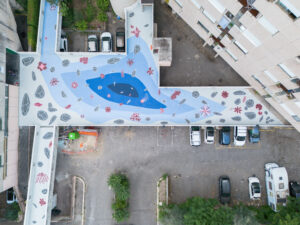
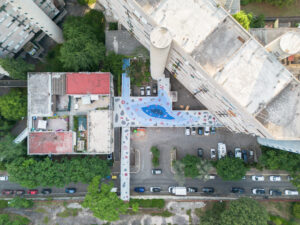
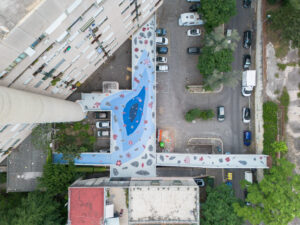
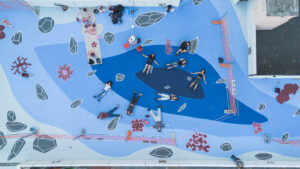
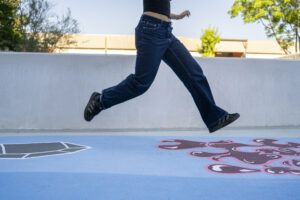
The artistic intervention accompanies the renovation of the square, its parapets and pedestrian surfaces. Using European project funding, ATER Roma restored the area, previously in a state of serious deterioration, and prepared it to host the artwork. The transformation therefore concerns both the physical quality of the spaces and opportunities for people to meet and use the space in everyday life. Residents’ responses evolved during the work: initial curiosity and, in some cases, distrust gradually gave way to increasingly active and positive participation. Today, the street painting functions as an experiential and relational space, conceived to encourage well-being, play and everyday interaction, particularly among younger generations.
An open-air playground
The playful dimension emerged as soon as people began crossing the square after the intervention: young pedestrians started jumping from one shape to another, while people using bicycles, scooters or wheelchairs explored slalom-like routes between the painted elements. The invitation to play was taken up spontaneously, without any instructions.